| Island Life | ||
|
the community website serving the Channel Islands celebrating 18 years 2000 - 2018 |
||
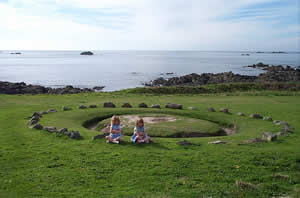
History of the Channel IslandsNeolithic ManOriginally part of the mainland, the islands were formed after the Ice Age around 6,500 BC. The Channel Islands are steeped in history and discoveries in the 20th & 21st centuries have shown evidence of mankind dating back to 4,500 BC (early Neolithic Age) when tribes, possibly from Spain moved here. All around Guernsey are traces of neolithic man, including defensive earth works, menhirs and dolmens. These are burial chambers built above the ground and several survive in remarkably good condition.
The largest in Guernsey, La Varde Dolmen is near the 17th green of L'Ancresse golf course and measures 11 metres long by four metres wide and has a capping stone pile of five metres long and one metre thick. One cannot even start to imagine how early man could have moved such stones into position. Further dolmens can be found at Hougue de Dehus, which has a burial Chamber of for 10 metres by 1.5 metres , Le Creux es Feies (the fairy grotto) and Le Trepid near to Le Catioroc which Victor Hugo claimed was haunted by the cries of women waiting for their lover, the devil. As mentioned in the section on churches, human figures carved out of granite have also had survived from around 2500. Celts probably from France and Germany, from around 800BC have also left their mark. See Ancient Monuments Guernsey and Ancient Monuments Jersey for more details. Iron AgeIn Alderney, Fort Tourgis has remains of a tomb a lot more interesting are the Iron Age pieces of pottery found nearby and now in the Alderney the scheme. These pieces have been dated to around 500 BC with a Potter's workshop and a settlement having been discovered in 1968 together with bronze age instruments. Back in Guernsey, excavations at Jerbourg revealed Iron Age earthworks and elsewhere long swords spear heads and beads have been found in tombs. It is also known that at the Vale Castle site a fort dating back to around 550BC was built there. Iron Age salt pans have also been found in Herm. RomansSeveral excavations in St Peter Port prior to rebuilding works in the late twentieth-century have confirmed that the Romans used the island as a trading base and probably stayed here for around 250 years. A third century shipwreck discovered in the mouth of St Peter Port harbour 1n 1982 is known to be the Roman ship "Asterix"and is now on display in Castle Cornet. The Romans named Guernsey, Alderney and Jersey as Sarnia, Riduna and Caesarea respectively. The endings on the current names "ey" are viking meaning island. The legions were ruled from Lyons although they enjoyed some independence. Christianity arrivesAfter the collapse of the Roman Empire, came the Dark Ages and history remains vague. It is known that St Magloire went to Sark in 550AD and from there friars were dispatched to the other Channel Islands. St Helier arrived in Jersey at around the same time but was murdered in 556. VikingsThe Vikings started to make their mark around the Seine and Loire areas. In 911 Rollo took control of Caen from the inhabitants of Breton and history tells us that it was ceded to him by Charles the Simple. This was the beginning of the Duchy of Normandy and William Longsword added the Cotentin peninsular in 933. A Viking longhouse was found at Cobo and also in St Helier. William the ConquerorThe recent history of the islands can therefore be traced back quite clearly to Norman times and Islanders proudly state that their ancestors were part of the forces of William the Conqueror which defeated England in 1066. In fact since around 933, when Rollo's son William Longsword added the islands to the dukedom of Normandy, the inhabitants of these islands have been answerable only to the Duke of Normandy and his successors, the British sovereign. When Guillaume Duke of Normandy conquered England in 1066, he became King William I as well as Duke of Normandy. However when King John lost the territory of Normandy to Philip II of France, the Channel Islands remained loyal to the English crown. In return for this loyalty, King John granted to the islands, certain rights and privileges in 1215 which enabled them to be virtually self-governing, subject only to Royal assent and enactments through the Privy Council. In 1294 a large part of the Guernsey population were killed in French raids. In fact over the ensuing centuries, possession of the islands switched back and forth between the English and French six times. Large castles were built most of which still survive today. In 1481 the States of Guernsey had been formed and Guernsey was already exporting woolens. In the 1600's privateering became commonplace and considerable wealth started to build up in the islands. This was legalised piracy licensed by the Crown to seize foreign ships. During the Reformation ,the islands swayed between Catholicism and Protestantism. John Wesley visited Guernsey in 1787 and Methodism flourished. Feudalism and LegendNorman law "Le Grand Coutumier" was introduced to the islands and was far ahead of anything else in those times. Its influence continues right through to the present day where such ancients rights as the Calameur de Haro still exist alongside English influenced statutes, a thousand years later. This is when an islander believes that he or she is being wronged or cheated. The ancient law requires that the alleged threat or injustice ceases immediately and after reciting the Lord's prayer in French, a written case must be submitted to the Bailiff and two Jurats within 24 hours. A local Patois language based on Norman French developed in each island and can still be heard being spoken by a dwindling number of locals. It even varied by the parish one was brought up in. La Societe Guernesiaise is trying to preserve it through recordings and a dictionary and through selected teaching in island schools. Whilst England was developing a parliamentary system, the islands continued in their feudal past. The Fiefs created by the Normans continued to thrive and it was only in the 1960s that their powers were finally killed off in Guernsey although in Sark they remain. Most property owners are still obliged to pay conge (2% of the purchase price) which used to be payable to the Seigneurs, but is now paid as tax to the island government. Some property owners still have to pay Chef-rente as a small tax and Poulage (originally two chickens, but now a nominal sum). Quarantaine (40 eggs) also used to be payable to the seigneur bu this is now also a nominal sum. A Tithe (the eleventh sheath of all cereal crops also had to be apid over. The Seigneur of Sark remains the sole Lord of the Manor, the head of one of Europe's last remaining feudal societies alongside Andorra. The English Crown appointed a Warden to each island, called a Captain but later with the military influence, he became known a the Governor. Very few took up residence and Lieutenant Governors (lieu-tenant being French for "place holding") were appointed. Legends Live onAs in other parts of Europe, the islands are steeped in legend and witchcraft was rife in the Middle Ages. Guernsey convicted on average one witch a year for 150 years and one Bailiff the feared Amice de Carteret was responsible for sending 35 women to their death in a thirty five year period up to 1635. In 1640 a woman said to be 80 years old was burned at the stake. The last witch trial in Guernsey was as recently as 1914, but he sentence thankfully was eight days hard labour. It was said that the witches favourite meeting places were at Fort Grey and Le Catioroc and usually on Fridays. Longue Hougue nearby, was supposed to be the cricket bat of the little folk.
It was reported in the 1800s that a man in St Saviour tried to rid himself of spell bound books which belonged to his father. When he tried to burn them, the fire went out, the well he threw them in went dry and finally buried them in manure. The "affectionate" names islanders call themselves, seem to date back centuries and the word nickname refers to the devil himself. Guerns still call Jersey folk "Crapaud" (toads) and Guerns are referred to as donkeys. Alderney folk are often referred to as cows and Sarkese natives as crows. One other legend tells the story of the man who demolished an ancient stone La Rocque qui Sonne", literally the Singing Rock. It used to stand in the field of a Mr Hocart in the Vale but against local advice used some of the stone to build a house but this burned down killing two occupants. Some of it was shipped to England but two ships carrying it sank. Even his home in Alderney burned down and he died sailing back to Guernsey when the ship's rigging collapsed onto him. It was always said that Tchico an evil black dog roamed the streets at night and was a warning of bad news to come. In St Peter Port, it was often said that the roamed Tower Hill, where executions took place in centuries gone by. In Sark, their own version of Tchico roams La Coupee. NapoleonIn the 1800's, wealthy French residents fleeing the revolution, set up home in the islands and many of the Town houses one sees today were built during this era. In St Peter Port, much of the harbour had been built by 1865. German OccupationDuring 1940-1945, the islands were occupied by German forces and huge numbers of defensive positions were built as part of Hitler's Atlantic Wall. By 1944, most islanders were near to starvation and a Red Cross ship carrying supplies in 1944 was a very welcome site. The islands were liberated in May 1945 and every year islanders celebrate their freedom on 9th May. Offshore FinanceThe 1960's onwards have seen large increases in population in most of the Channel Islands. Stable government and a lack of party politics has encouraged Banking and Finance generally, to be the main income earners from the 1970's onwards and has brought huge wealth to Guernsey and Jersey and a respectable standing in the upper division of the world of Offshore Finance centres. New MillenniumAs with elsewhere in the World, fast technological change has been a feature of the 1980s and 1990s and as the new Millennium appeared, the islands were gearing themselves up for e-commerce. Alderney has gained an enviable reputation for being a well regulated e-betting location with 14 online betting companies licensed there as early as 2004 and hosting of the servers out of Guernsey.
| ||||

Search the Site
|
Follow us on Twitter |
Find us on Facebook |
|
|
 |

Home Site Map Contact Terms of Use
Copyright © 2011 Island Life.