| Island Life | ||
|
the community website serving the Channel Islands celebrating 18 years 2000 - 2018 |
||
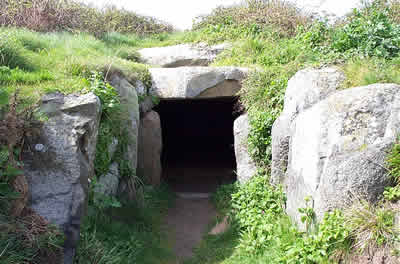
Guernsey AttractionsAncient MonumentsLike the rest of the Channel Islands, Guernsey is steeped in history. Up to 6,500BC, the islands were in fact part of the French mainland until the Ice Age came to an end. Discoveries in the 20th century have shown evidence of mankind dating back to 5,000 BC (New Stone Age) when tribes, possibly from Spain moved here. All around Guernsey are traces of neolithic man, including defensive earth works, menhirs and dolmens. These are burial chambers built above the ground and several survive in remarkably good condition. The largest in Guernsey, La Varde Dolmen is near the 17th green of L'Ancresse golf course and measures 10 metres long by four metres wide and has a capping stone pile of five metres long and one metre thick. Further dolmens can be found at Hougue de Dehus, which has a burial Chamber of for 10 metres by 1.5 metres , Le Creux es Feies (the fairy grotto) and Le Trepid near to Le Catioroc which Victor Hugo claimed was haunted by the cries of women waiting for their lover, the devil. As mentioned in the section on churches, human figures carved out of granite have also had survived from around 2500. In January 2001, an excavation at La Route de Carteret has revealed two sophisticated arrow heads, thought to be at least 6,000 years old. They will go on display in the summer along with other material from the site, which will shortly be built on. A new archaeological dig in the marshy Belgrave Vinery site in the Vale got underway in June 2001. Early finds were promising with the discovery of a substantial standing stone thought to date back to 4,000 BC. The area is very low lying, has medieval drainage and is thought not to have been developed upon since the Duke of Richmond's map of 1787. A major housing development is being built on the site. In June 2011, Delancey Park's Neothlithic grave believed to be over 4,500 years old will undergo a full excavation led by Dr George Nash from Bristol University. The dig will be over 12 days and will aim to give a better undertstanding of the burial rituals. in 2010 test pits were dug and these revealed neolithic pottery and flint pieces. A lot of animal bones were also found and an archaeological zoologist will inspect these. A 20 feet long menhir weighing 28 tons found at L'Ancresse Bay, has been erected near to La Varde ancient tomb in April 2001 as part of the Vale's Millennium celebration. The massive stone has proven to be a logistic nightmare moving it from its sunken position in the sand to the common land. The project was first planned in 1999 but despite modern cranes and machinery, it has proven to be a massive task. It raises questions as to how neolithic man managed to erect these type of structures. It is hoped that it will still be there in another thousand years.
Medieval wreck siteThe most important medieval wreck site in NW Europe near St Peter Port Harbour mouth is larger than first thought. There may be as many as five or more wrecks dating back to 14th century. Guernsey was an important trading point between France and England. A large amount of pottery from the Saintonge region of France has been found, suggesting that the ship was carrying a consignment of earthenware. Erosion and heavy sea traffic is resulting in the wrecks breaking up and timber is being washed away. Southampton University is engaged in analysing the timbers and if funds can be raised, the wrecks may be lifted. Excavations in the Bonded Store area under Market street have also revealed medieval artefacts including pottery, ceramics, a Venus figurine and a small jewel called Intaglis. They have helped build up a picture back to Roman times. The Archaeology department hope to publish a book about Roman Guernsey, later in the year. | |||||||||||||||||||||||||||||||||||




Search the Site
|
Follow us on Twitter |
Find us on Facebook |
|
|
 |

Home Site Map Contact Terms of Use
Copyright © 2011 Island Life.