Throughout his career James Saumarez was
involved in many notable moments of naval history. He was involved with the War
of American Independence and was even offered a commission in the army, which
he turned down and continued serving in the navy, at that time onboard the HMS
Bristol.
Following this he was given command of a
schooner-rigged galley, the Spitfire, at the rank of lieutenant. Saumarez served
for a time as 3rd, and later 1st, Lieutenant aboard the HMS Victory and was
involved in the Battle of Dogger Bank against the Dutch.
As the captain of the HMS Crescent, with a crew of
mostly Guernseymen, he captured the 36-gun French frigate La Reunion off Cherbourg
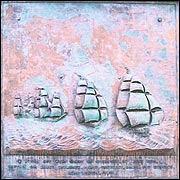
in 1793. An exciting Naval actions took place off the West Coast of Guernsey
as the Crescent escaped a French squadron through the local knowledge of a Guernsey
pilot.
At the Battle of the Nile in 1798 where Nelson was
severely injured, Saumarez was Nelson's second in command. In 1801 he was made a
baronet and a rear-admiral, making full admiral in 1814 following his time spent in
command of the Baltic squadron.
In 1803 Saumarez led the Channel Islands' squadron
with a fleet including six frigates and six brigs when the islands were made a
naval station.
 |
In 1821 he was elevated to
Vice-Admiral of Great Britain and made a Lord in 1831.
He later held the position of
Commander-In-Chief of the Baltic Fleet and it was during these
Baltic conflicts that Saumarez became a hero in Sweden.
Saumarez built a reputation as a
'Lucky Captain' and came home a very rich man indeed.
|
| A daring escape from a superior French fleet |
|
|
Following his death in 1836 the
Admiral was buried in the Saumarez family vault in the Castel
Churchyard.
His memory is still recognised by
the Royal Navy, Sweden and in Guernsey where the base of a 99 foot
tall monument remains in Delancey Park, following the demolition of
the monument by occupying forces during the Second World War. The
large brass plaques from the monument still hang on the walls of
Castle Cornet.
|
 |
| |
Saumarez as seen on the Delancey Monument |


